See / What is worth your time
Eight places.
Ranked.
In November 2026 we read the venues' own pages, the city's English site, local gazetteers and a 2026 report on the ferry. This guide tells you what a place is, why it matters, what it costs and what will annoy you — and says plainly where we still could not verify something.
Wuhan's best half-day is Wuchang: the Yellow Crane Tower, the Hubei Provincial Museum (free, but book ahead — a foreign passport works) and East Lake. Cross the river on the public ferry. The tower's official full ticket is $10.47¥70; the ferry is ≈$0.22¥1.5.
We are not based in Wuhan and we do not claim first-hand knowledge of these sites. What we can do is read the source documents: the Yellow Crane Tower's official price table and opening notice, the Hubei Provincial Museum's visitor rules, the East Lake authority's own profile, the 1911 museum's opening times, Wuhan University's English blossom policy, the city government's English pages, and official museum listings. Every number below is dated, graded and, where it is in yuan, shown in both currencies. Five things we still could not verify are collected in one place at the end rather than repeated eight times.
At a glance: the ranking
Ordered by how much they justify the crossing, not by fame. The last column is the part most guides leave out.
| # | Place | Town | Allow | Entry | The catch |
|---|---|---|---|---|---|
| 01 | Yellow Crane Tower | Wuchang | 2 h | $10.47¥70 | A 1985 building; the city's busiest single site |
| 02 | Hubei Provincial Museum | Wuchang | 3 h | Free, book ahead | Reservation is compulsory; closed Mondays |
| 03 | East Lake | Wuchang | Half a day | Not stated for all zones | Far too large to walk; pick one section |
| 04 | Yangtze ferry & First Bridge | Between towns | 1 h | ≈$0.22¥1.5 | Crowded at weekends; last departure 20:00 |
| 05 | Hankou riverfront & Jianghanguan | Hankou | 2 h | Free | Museum closed Mondays; Jianghan Road is just a shopping street |
| 06 | 1911 Revolution Museum | Wuchang | 1.5 h | Not stated | Two separate buildings with different closing days |
| 07 | Wuhan University blossom | Wuchang | 2 h, seasonal | Free in the 2025 policy | Access rules change every year; check before booking a trip |
| 08 | Hanyang: pavilion, terrace, temples | Hanyang | Half a day | Not stated | Spread out; least English-language information |
Wuchang: the half-day that justifies the trip
These three sit on the same side of the river and within a short ride of one another. Doing them together is the single most efficient use of a day in Wuhan.
Yellow Crane Tower
Wuchang · allow 2 hours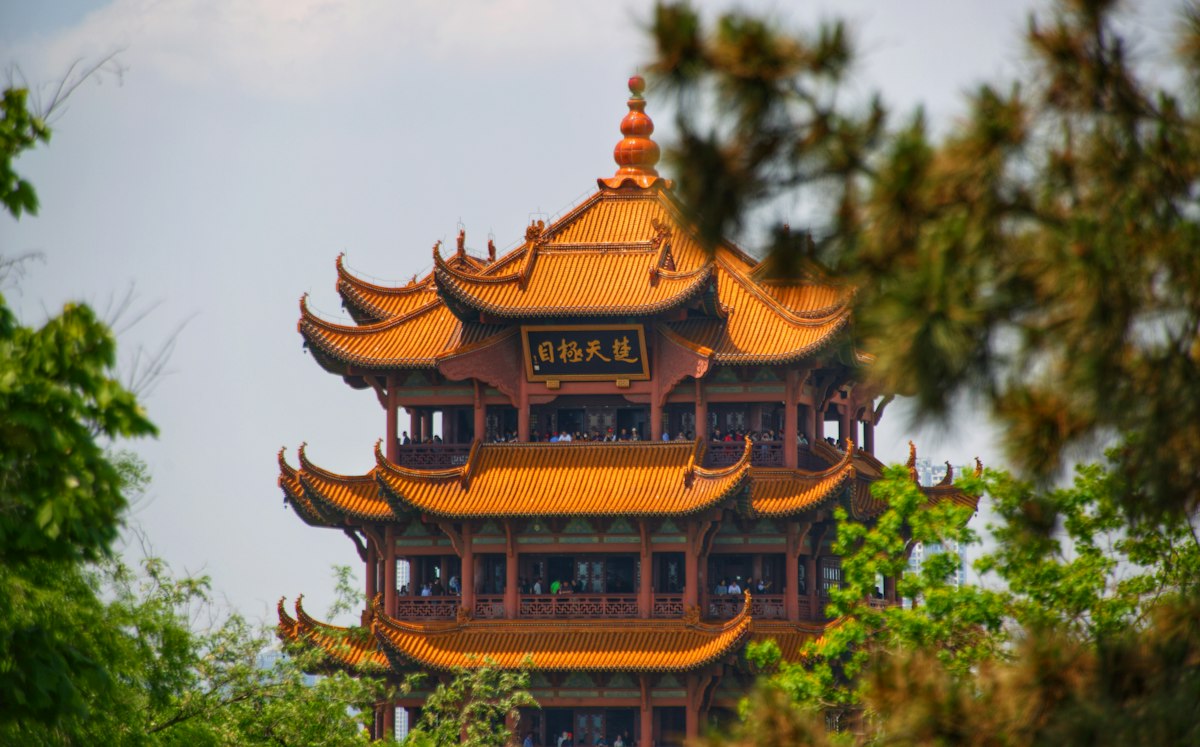
Go once. It is the city's symbol and the view is real — but the tower you climb is a 1985 building, and that changes what you are looking at.
The site began in 223 AD as a military watchtower on Snake Hill above the Yangtze; the name Wuchang itself comes from the garrison that built it. By the Tang dynasty it had become a place for banquets and views, and Cui Hao's eight-line poem 「昔人已乘黄鹤去,此地空余黄鹤楼」 — "the yellow crane has gone and will not return, this place is left with an empty tower" — made it one of the most quoted buildings in Chinese literature. It is grouped with Yueyang Tower and Tengwang Pavilion as one of the Three Great Towers south of the Yangtze.
Then the building kept disappearing. It was destroyed and rebuilt repeatedly through the Ming and Qing; the last old tower, built in 1868, burnt down in 1884 and was not replaced for a century. When the First Yangtze Bridge was built in 1957, its Wuchang approach ramp took over the original site at Yellow Crane Rock. The present tower was begun in October 1981 up on Snake Hill and completed in June 1985: five sweeping eaves, a reinforced-concrete frame imitating timber, 51.4 metres tall, modelled on the 1868 tower rather than reproducing it.
So this is a monument to a poem, not a surviving ancient structure. That is the interesting thing about it, not a reason to stay away. Inside, the five floors hold murals, couplets and plaques; outside are the White Cloud Pavilion, Goose Pond and Luomei Pavilion. From the top you look straight down onto the bridge and across to Turtle Hill — the railway trains cross below you while the river traffic passes underneath them.
- Why it matters
- A poem every Chinese reader knows, a tower rebuilt after a century's absence, and the reason the bridge and the hill belong to the same picture.
- What you see
- Five floors of murals and calligraphy, four subsidiary pavilions, and the working bridge from above.
- When to go
- Official Chinese notice: ticket sales 08:30–17:00, last entry 17:20, park clears at 18:00; the main tower closes 18:00, White Cloud Pavilion 17:30. The park's English page gives different seasonal hours, so treat the gate as final. Arrive early at weekends.
- What it costs
- Full ticket $10.47¥70, half ticket $5.23¥35, under a 2018 municipal pricing notice. Children under six or under 1.2 m, visitors over 65, serving military personnel and disabled visitors enter free; students and visitors aged 60–65 pay half. The park checks your ticket twice — once at the gate, once at the tower — and it is valid on that day only.
- Getting there
- On Snake Hill beside the Wuchang end of the First Yangtze Bridge. The public ferry from Hankou lands at Zhonghua Road, a short ride away, which makes the tower and the crossing a natural pair.
- The catch
- It is the busiest single site in the city, the ticket allows one entry to the park and one to the tower, and we found no official information about the separately marketed evening shows. Do not assume a night ticket exists.
Sources: park history, official admission policy and price table, English ticket policy, Xinhua on the 1957 relocation. Checked 2026-11 · fares Class A, history Class C.
Hubei Provincial Museum
Wuchang · allow 3 hours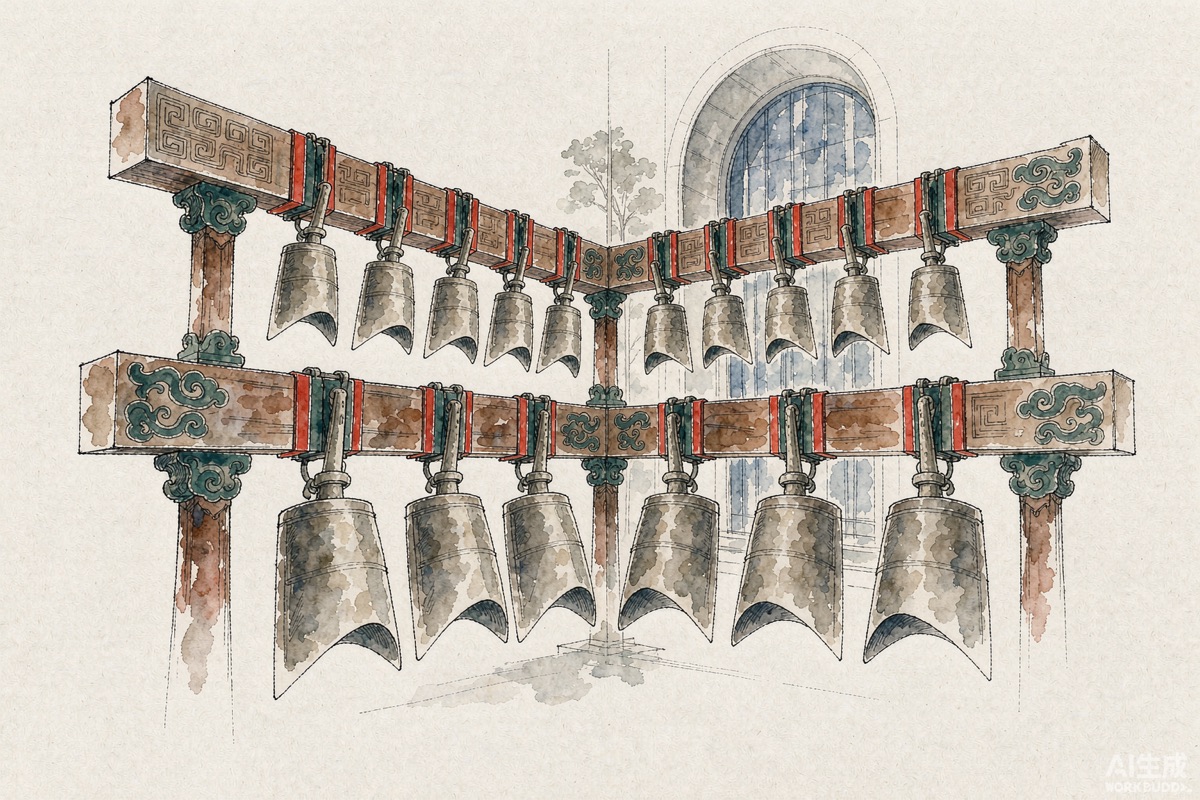
The best indoor half-day in Wuhan, and it costs nothing. The obstacle is the booking system, not the collection — and a foreign passport does work.
Founded in 1953 and moved to the shore of East Lake in 1956, the museum was completely rebuilt by the end of 2021, with a new opening ceremony on 20 December. It is one of the eight national key museums jointly supported by central and local government, and holds national first-grade museum status. The newer south building, shaped like the character 鼎 (a ritual bronze tripod), holds the thematic exhibitions; the north building carries the chronological history.
The reason to come is the bell set of Marquis Yi of Zeng, unearthed in 1978 from a tomb at Leigudun in Suizhou. Sixty-five bronze bells hang in three tiers and eight groups on an L-shaped frame, with 3,755 characters of inscription cast into the bells, frame and hooks. Each bell produces two distinct pitches a third apart depending on where it is struck, and the set spans roughly five octaves with all twelve semitones — which is why the find is routinely described as having rewritten the history of music. These are not replicas and not an audio installation; they are playable 2,400-year-old instruments. The museum runs four short bell performances each day.
The other object people cross a city for is the Sword of Goujian, found in 1965 in a Chu tomb at Wangshan in Jiangling, 55.6 cm long, with a bird-script inscription naming its owner. Together with the Zenghou Yi zun-pan, the painted lacquer drum stand, the Qin bamboo slips from Shuihudi and the Yuan blue-and-white plum vase, it makes the point of this collection: it is about Chu, the southern state with its own quite separate aesthetic, not a regional footnote to the Yellow River story.
- Why it matters
- One of China's eight national key museums; the bells are the strongest single object in the city.
- What you see
- South building: the bells, the sword, Chu at eight centuries, and themed galleries. North building: the through-history display. Bell performances at 10:30, 11:30, 14:00 and 15:00.
- When to go
- Closed Mondays except public holidays. Tuesday to Sunday 09:00–17:00, last entry 16:00; in summer (before 31 August) 08:30–17:30. Book no more than five days ahead — new slots release at midnight, and same-day bookings must be made before 16:00 if any remain.
- What it costs
- Free, with compulsory real-name reservation. Guided tours are extra: $14.95¥100 for a Chinese-language group and $29.91¥200 for English, each covering up to 90 minutes with an hourly surcharge; book by phone one to seven days ahead.
- Foreign passports
- Confirmed on the museum's own visitor page. Book using your passport, then on the day bring the physical passport and the QR code the system generates — non-ID bookings are scanned by hand-held device rather than at the turnstile. Only five booking channels are authorised: the museum website, its WeChat account, the Meituan app, Hubei Wenlv Zhisheng and Ehuiban. The museum states that no other third party is authorised to sell entry.
- The catch
- There are four fixed entry slots and arriving early or late is refused; three no-shows put you on a blacklist for six months. Monday is closed, and the reservation system was still being upgraded in October 2026 — check the site the day before.
Sources: museum visitor rules, museum history and rebuilding, October 2026 booking-system notice, Hubei Provincial Department of Culture and Tourism on the bells, Wuhan city government English listing. Checked 2026-11 · Class A.
East Lake
Wuchang · half a day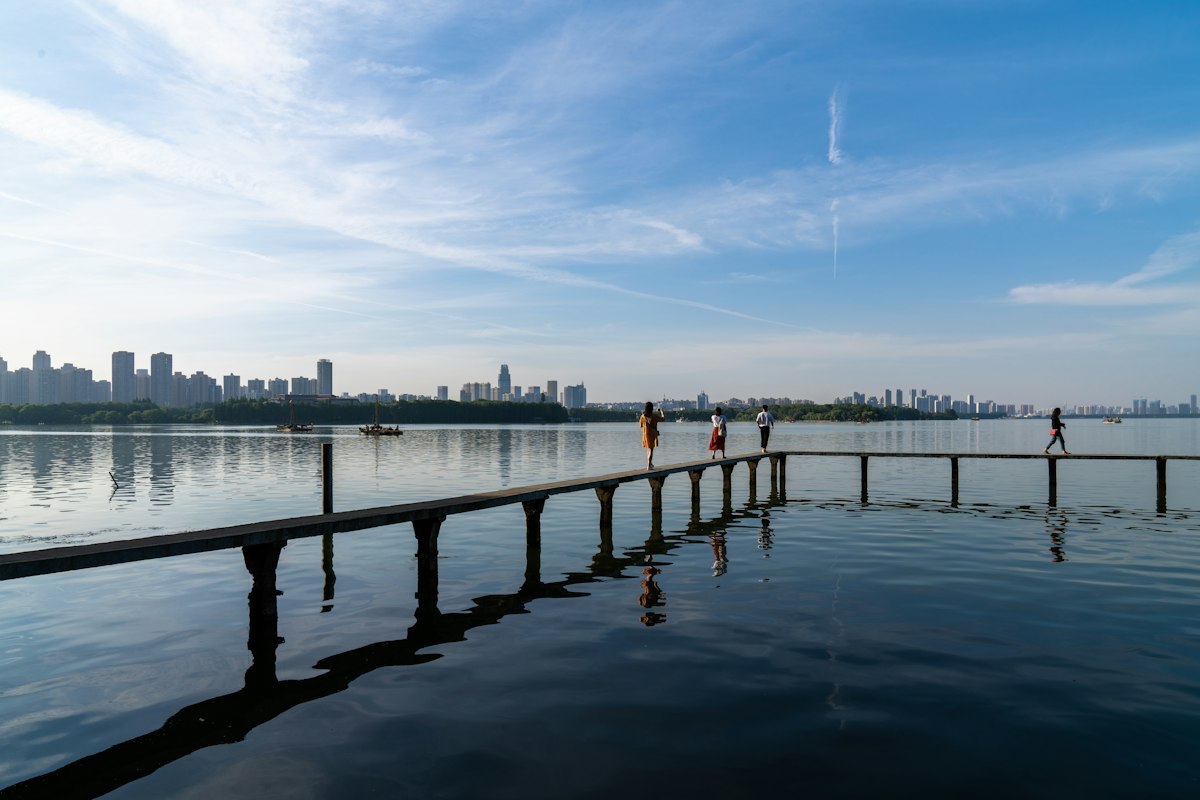
A lake on a scale that is hard to grasp until you are on it. Pick one section, hire a bike, and do not plan to walk around it.
The East Lake authority's own 2026 profile gives about 34 square kilometres of water inside an 81.68 km² administrative area, with ten separate lakes and four core scenic zones: Tingtao, Moshan, Luoyan and Chuidi. The site calls it China's largest urban lake, a title that has been disputed since Tangxun Lake was absorbed into the built-up area — treat the superlative as marketing and the size as real.
The park began in 1930 as a private garden called Haiguang Nongpu, was named among the first batch of national key scenic areas in 1982, and now holds 5A status. Its older stories are Chu stories: Qu Yuan is said to have walked the shore composing, Liu Bei performed a ceremony at Moshan, and Li Bai flew hawks here. The greenway runs roughly 100 km in seven themed sections — the authority's current page says 105 km, an earlier official document 101.98 km, so we give the round figure. Moshan also holds a cherry garden with dozens of cultivars, which is the practical fallback when campus access at Wuhan University is restricted.
The lake explains the map. The provincial museum sits on its shore and the university on the hill beside it, which is why one Wuchang day can hold all three without ever crossing a river.
- Why it matters
- The largest piece of open water inside a Chinese city of this size, and the reason the museum and university are where they are.
- What you see
- Four named zones, a long lakeside greenway for cycling, Moshan's specialist plant gardens and the cherry garden.
- When to go
- Early morning or late afternoon; midday in summer is punishing. Cherry season falls in the second half of March.
- Getting there
- Adjacent to the provincial museum and close to Wuhan University; combine all three in one Wuchang day.
- The catch
- Distances between zones are large and the greenway is far longer than a pleasant walk. We did not verify whether individual zones, the cherry garden or bike hire charge separately, so budget for that uncertainty rather than assuming everything inside the park is free.
Source: East Lake Scenic Area authority profile, dated 15 January 2026; greenway length cross-checked against an official 2017 document. Checked 2026-11 · Class C.
Across the river: the city itself
The Yangtze ferry and the First Bridge
Between the towns · allow 1 hour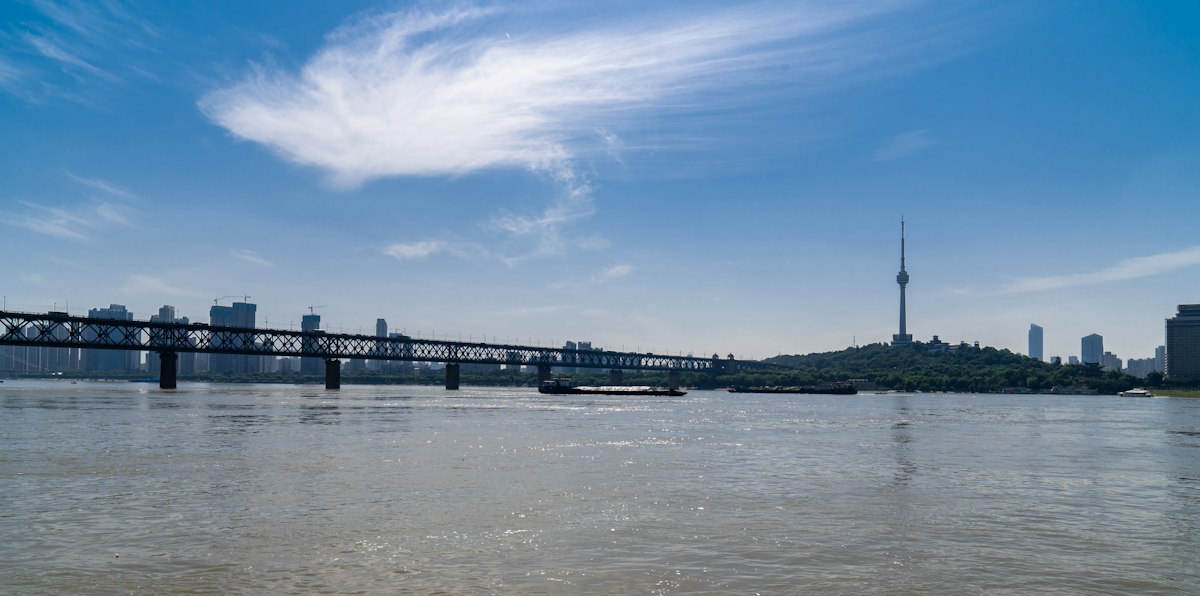
The cheapest and most honest way to understand a city split by a river. One crossing shows you the tower, the bridge and the Hankou skyline.
Until October 1957 there was no bridge across the Yangtze at Wuhan; the ferry was the only way over. The Wuhan Yangtze River Bridge — the first on the river — opened that month, linking Turtle Hill in Hanyang with Snake Hill in Wuchang. It carries road traffic on the upper deck and a double-track railway below, joining the old Beijing–Hankou and Guangzhou–Wuchang lines into the present Beijing–Guangzhou route. Its Wuchang approach ramp is also why the Yellow Crane Tower had to be rebuilt on a different spot: the two sights are causally connected, not just nearby.
Stand on the Wuchang bank and the city's whole logic becomes visible at once — Snake Hill, the tower above it, the bridge leaving the hill, Turtle Hill opposite, and the customs-house clock on the Hankou side. A municipal ferry gives you that view for the price of a bus ticket, and delivers you a few steps from the old concession buildings. Wuhan's first scheduled ferry route opened in 1900 between Hanyangmen and Wangjiaxiang; the classic line today is the Wuzhong route between Zhonghua Road Pier No. 1 and Wuhan Guan Pier.
The upper deck was closed on safety grounds in 2024 and reopened at the end of April 2026 after anti-slip work and new protective netting — worth knowing, because older guides still describe the view from the lower deck only. During the 2026 May holiday the line carried more than 60,000 passengers on its busiest day; it is now a visitor attraction as much as a commuter service.
- Why it matters
- The bridge ended a city that depended entirely on boats; the ferry is the surviving piece of that older city.
- What you see
- From the water: the Yellow Crane Tower, the bridge, Turtle Hill television tower and the Hankou riverfront in one sweep.
- When to go
- Daily 06:30–20:00, with departures every 20 minutes at peak times. Go at dusk if you can; weekends and holidays are crowded.
- What it costs
- A single crossing on the Wuzhong line is ≈$0.22¥1.5 — a figure reported by People's Daily in May 2026, not taken from an operator's tariff sheet, so it carries a reported label.
- The catch
- After 20:00 you need the metro or a taxi. We could not verify luggage rules, the full route list or whether the upper deck stays open in bad weather; ask at the pier.
Sources: Wuhan city government on the 1957 bridge, People's Daily Hubei, 22 May 2026, on the ferry, Xinhua on the tower's relocation. Checked 2026-11 · fare Class B, history Class C.
Hankou riverfront, Jianghanguan and Jianghan Road
Hankou · allow 2 hours on foot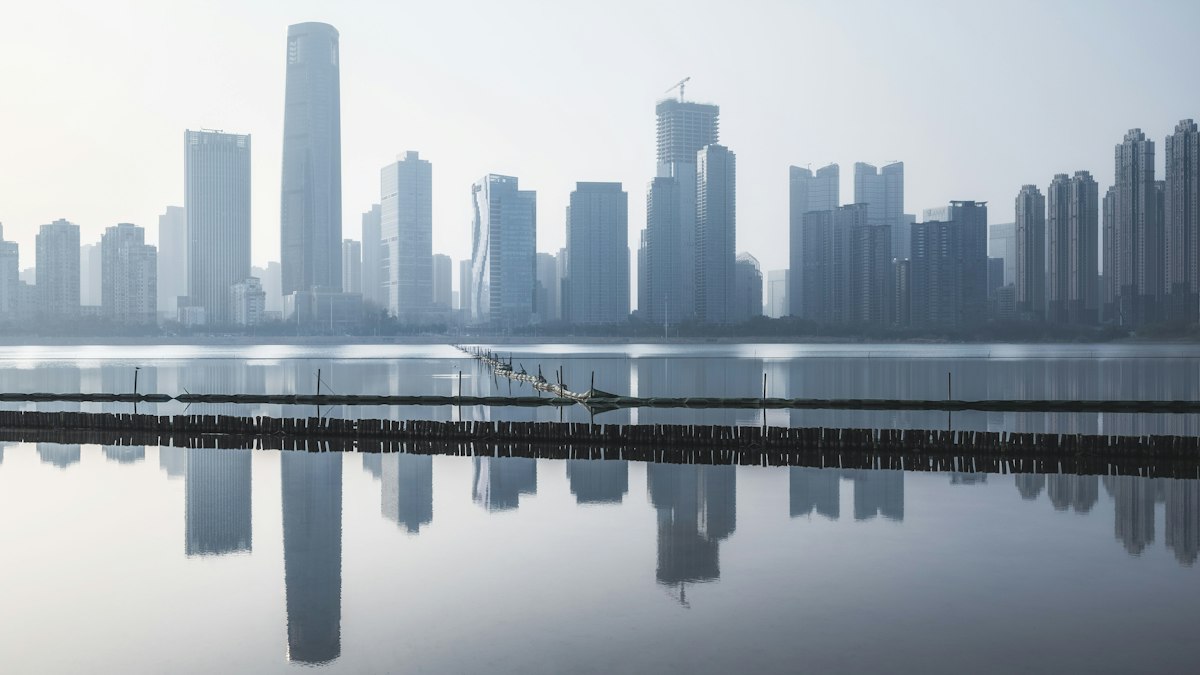
The best free walk in Wuhan, and the part most short-stop guides leave out. Go at dusk, when the customs house and the riverfront are both lit.
Hankou opened as a treaty port in 1861, when Britain established the first concession. Germany followed in 1895, Russia and France in 1896, Japan in 1898; together the five concessions covered roughly 2.2 km² along the river. Britain's concession was recovered in February 1927. What remains is a dense strip of customs houses, banks and trading-company buildings — the Jianghan district government calls Jianghan Road "a museum of twentieth-century Wuhan architecture".
The anchor is the Jianghanguan building. The customs house itself dates to 1862; the present four-storey block was completed in 1924 to a British architect's design, stood about 46 metres high and was the tallest building in Wuhan at the time. Its clock tower began striking on 18 January 1924 and plays the Westminster chimes. In 2015 the building became a museum, rated a national second-grade museum in 2020, with a permanent exhibition on Wuhan's modernisation that starts from the 1861 opening of the port. The building that once collected the duties now explains what those duties did to the city — the exhibits and the street outside are the same story.
Jianghan Road runs inland from it: laid out in 1861 as Taiping Road, renamed in 1906 and again in 1927, converted into a 1,600-metre pedestrian street in 2000. It is pleasant but ordinary as a shopping street; the value is in the façades and in the side streets behind them.
- Why it matters
- This is where Wuhan became an international trading city, and the architecture is the primary document.
- What you see
- The 1924 customs house and its clock, the riverfront promenade, concession-era façades, and the pedestrian street running north.
- When to go
- Jianghanguan Museum: 09:00–17:00, last entry 16:00, closed Mondays except public holidays, free. The riverfront itself is open later; the buildings are best at dusk.
- Getting there
- 129 Yanjiang Avenue; metro Lines 2 and 6 to Jianghan Road station, exit C. Wuhan Guan ferry pier is beside the museum, so this pairs directly with the crossing above.
- The catch
- The museum closes on Mondays, the shopping street is not a reason to cross the city on its own, and most of the concession buildings can only be appreciated from outside.
Sources: Wuhan municipal organs working committee: Jianghanguan Museum visitor guide, Wuhan municipal gazetteer on the concessions, Wuhan commerce bureau and Jianghan district government on Jianghan Road. Checked 2026-11 · hours Class B, history Class C.
History, if you have a second day
The 1911 Revolution Museum
Wuchang · allow 1.5 hours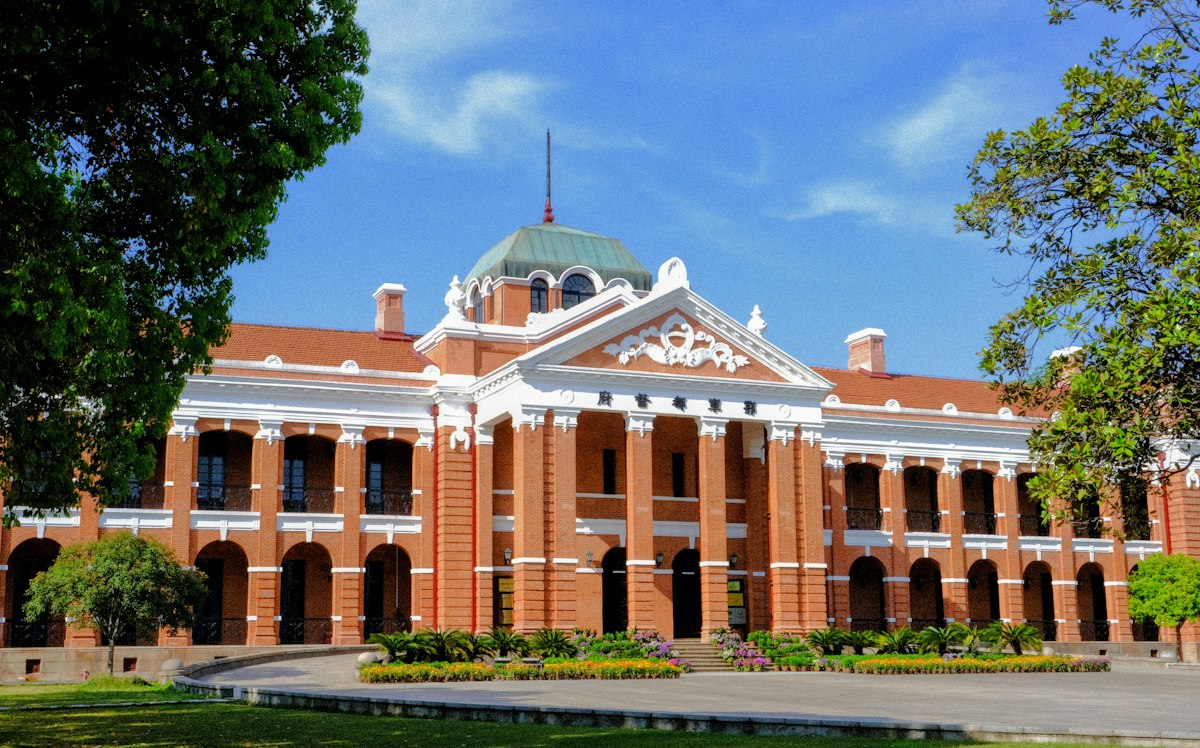
A compact indoor stop that explains why imperial China ended here rather than in Beijing or Nanjing. Confusingly, it is two buildings with two different closing days.
On the night of 10 October 1911, the engineering battalion of the New Army fired the first shots in Wuchang; by morning the city was taken and the Hubei military government had been formed. Provinces declared support in the weeks that followed, and on 12 February 1912 the last emperor abdicated, ending more than two thousand years of imperial rule. The red building at 1 Wuluo Road — built in 1910 as the Hubei provincial assembly, and the headquarters of that provisional government — is the physical starting point of the republic.
The naming is genuinely confusing. In March 2022 two institutions were merged into the 1911 Revolution Museum: the North site is the older memorial hall beside the Red Building (opened in 1981 around the 1961 national protected site), while the South site is a modern purpose-built museum from 2011 on Pengliuyang Road, with a V-shaped "Chu red" form. The North site's permanent display, Daring to Be First, covers the uprising in five parts. The square between them connects north towards the Yellow Crane Tower and Snake Hill, and south towards the Uprising Gate — the only one of Wuchang's ten Qing city gates still standing, renamed in 1912.
If you only have an hour, choose the North site: it is the actual building where the proclamation was made, not a reconstruction of one.
- Why it matters
- The 1911 uprising is the single event that gives Wuhan a place in modern Chinese history, and the Red Building is its surviving witness.
- What you see
- North: the Red Building and the five-part uprising display. South: a modern thematic museum across the square. Uprising Gate is a short walk further south.
- When to go
- Opens 09:00, last entry 16:00, closes 17:00. The South site closes on Mondays, the North site on Tuesdays, except public holidays — a useful piece of information if one of your days is a Monday.
- Getting there
- Shouyi Square in Wuchang, on the same side of the river as the tower; the two combine into a half-day on foot.
- The catch
- The official homepage states opening times but no ticket price or reservation rule, so we will not claim it is free. Two sites under one name with different closing days is an easy way to waste a morning.
Source: official museum site, opening times and permanent exhibition; institutional history from Wuhan municipal sources, 2025. Checked 2026-11 · hours Class B, history Class C.
Wuhan University cherry blossom
Wuchang · seasonal, late March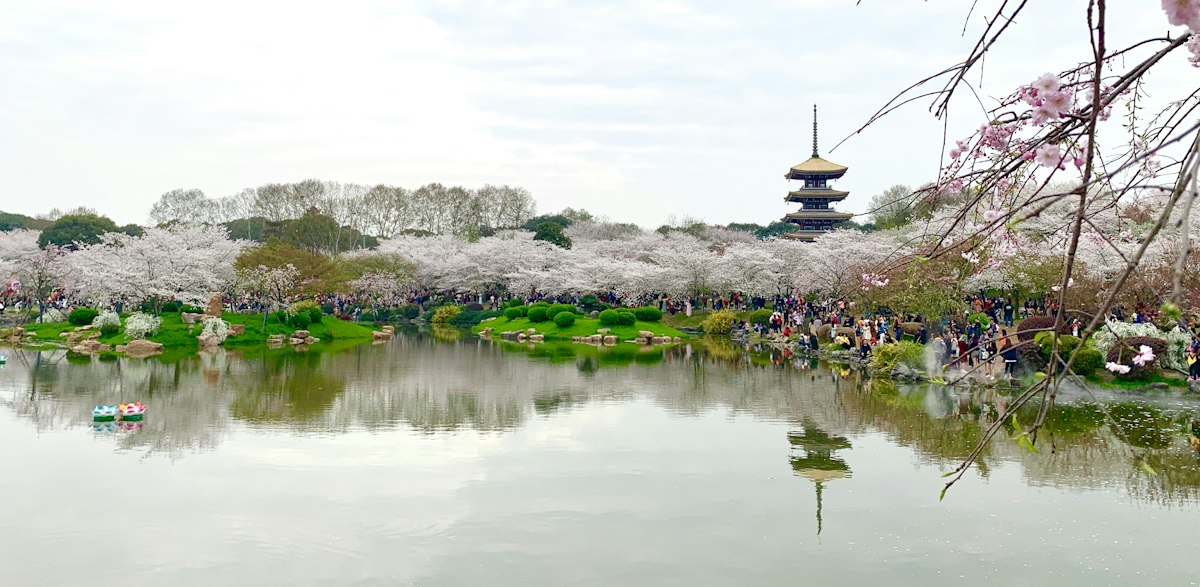
Worth it in late March, with a hard condition: campus access is a reservation system that changes every year. Never build a trip around it without checking.
The trees have a complicated twentieth-century history. The first were planted during the Japanese occupation in 1939; later batches arrived as diplomatic gifts after the normalisation of Sino-Japanese relations in 1972, and further gifts followed in the 1980s and 1990s. They sit against the 1930s dormitory buildings on Lion Hill — the old quarters and the "cherry terrace" are nationally protected architecture — which is part of why the blossom reads as a campus scene rather than simply a large planting.
The university's own English policy for the 2025 season opened the campus partially from 12 to 31 March, subject to flowering dates. All visitors needed a free real-name reservation made three days ahead through the university website or WeChat account, with the booking window opening at 20:00 each evening. Daily caps were 20,000 on weekdays and 40,000 at weekends; entry was through four named gates with a second check before the blossom areas, and the university explicitly warned against scams offering paid entry or "official" guided access.
Those are 2025 rules, not current ones. A secondary source reports that visitor reservations were stopped from May 2026, but we could not confirm that with the university, and the 2027 blossom policy had not been published when we checked.
- Why it matters
- The best-known seasonal image of Wuhan, and a reminder that the campus is a protected historic site.
- When to go
- Roughly the last three weeks of March, shifting with the flowering. Check the university's English site in February for the year's notice.
- What it costs
- Free under the 2025 policy; the university warns that paid-entry offers are scams. Do not pay anyone for access.
- The catch
- Daily caps, fixed gates, a three-day booking window and a policy rewritten each spring. East Lake's cherry garden is the workable fallback, and the season guide covers the wider timing.
Source: Wuhan University, 2025 cherry blossom viewing policy, 17 March 2025; tree and building history from Chinese press and university summaries (secondary). Checked 2026-11 · 2027 policy unverified.
Hanyang: Qingchuan Pavilion, Guqin Terrace and two temples
Hanyang · half a day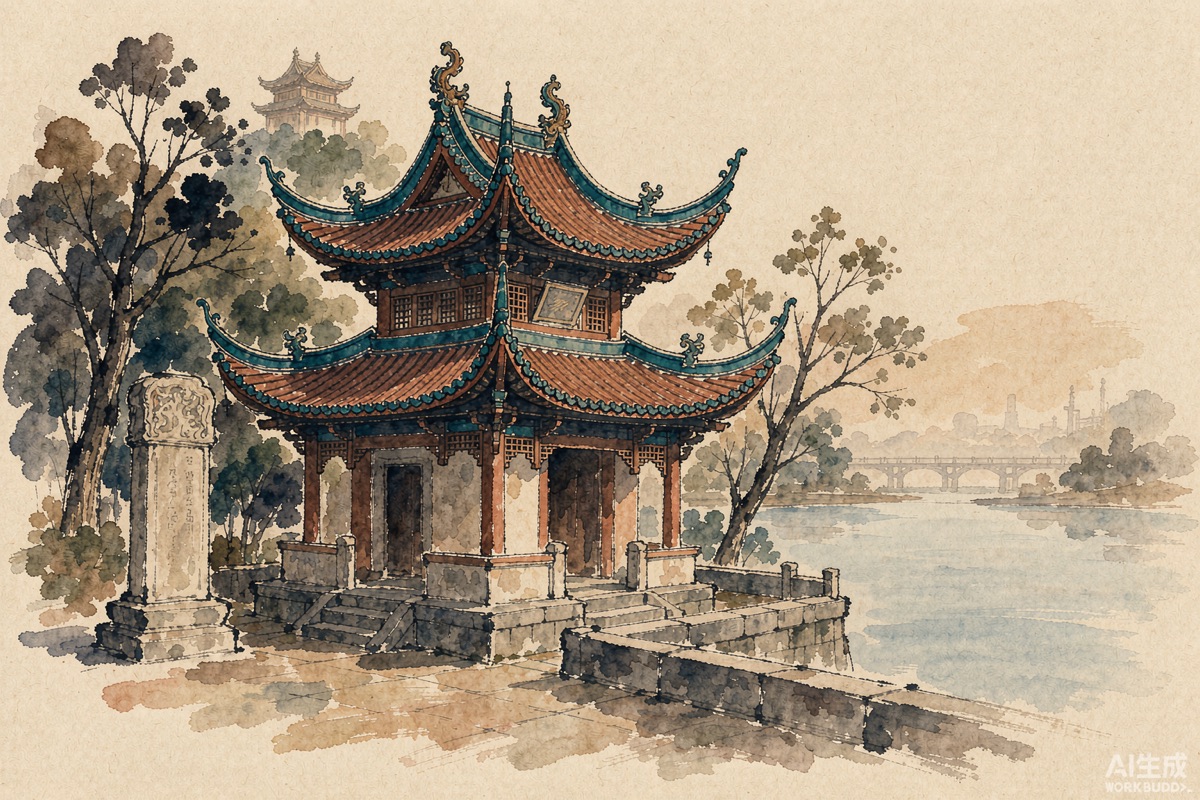
The quiet half-day across the river. Take it if you have a third day, or if the Wuchang museums are closed.
Qingchuan Pavilion is, in the city government's words, the only scenic and historical site in Wuhan that stands right beside the Yangtze. Built in the Chu style, its 17.5-metre main building has a granite base, red walls and columns and layered eaves; it faces the Yellow Crane Tower across the water. If you want to photograph the tower with the river in front of it, this is where you stand. With the Guqin Terrace it forms part of the group traditionally called Wuhan's three great sights.
The Guqin Terrace is about a story rather than a view: the friendship of Yu Boya and Zhong Ziqi, and the piece High Mountains and Flowing Water that gave Chinese the phrase zhiyin — the one person who truly understands your music. The site holds Qing-dynasty relics including a white marble figure of Yu Boya playing the qin, an imperial inscription by the Daoguang Emperor and three stone tablets.
Two temples are often added, with a caveat. Guiyuan Temple dates to 1658 and its Arhat Hall, added in 1834, holds five hundred gilded clay figures; the local custom is to count along the rows by your own age and take a verse from the last figure you reach. Gude Temple began as a small hermitage in 1877 and its main hall was built during the 1921–1934 rebuilding; its entrance is widely compared to Ananda Temple in Myanmar and its windows borrow Gothic details, but published accounts state plainly that the designer has never been identified. We found no first-hand architectural source for either temple, so treat those descriptions as orientation, not scholarship.
- Why it matters
- The city's oldest story (zhiyin) and its best reverse view of the tower, on the side of the river most visitors never reach.
- What you see
- A Chu-style riverside pavilion, a small classical garden with Qing stelae, a hall of five hundred arhats, and an unusually hybrid Buddhist main hall.
- Getting there
- Hanyang, below Turtle Hill beside the First Bridge; the sites are spread out and easiest reached by taxi from the bridge area.
- The catch
- We could not verify opening hours, entry fees or reservation rules for any of the four, and English-language material is thinnest here. Check locally before committing a morning.
Sources: Wuhan city government English feature on Hanyang, Qingchuan Pavilion and the Guqin Terrace; temple descriptions from Wuhan gazetteer and Chinese press summaries (secondary). Checked 2026-11 · Class C.
A note on Hubu Alley
Hubu Alley, beside the Yellow Crane Tower, is a modern tourist snack strip — crowded and priced for visitors. If you are already next door, it is fine to walk through in passing; for the meal itself, a neighbourhood breakfast stall serves the same city better for roughly ≈$0.75–1.20¥5–8. The eat guide.
Beyond the eight: the rest of the city, by category
The eight entries above are the ones we would defend ranking. These are the other places a longer stay or a specific interest points to — real and findable, but not ranked, and none of their hours, prices or booking rules are verified, so no such details appear here. Chinese names are given because taxi drivers and map apps work from them.
Temples & religious sites
- Guiyuan Temple 归元禅寺 · Hanyang — the 1658 Chan temple with the five-hundred-arhat hall, described in entry 08 above.
- Gude Temple 古德寺 · Hankou — the hybrid Buddhist hall mixing Burmese and Gothic elements, also described in entry 08.
- Baotong Temple 宝通禅寺 · Wuchang — a working Buddhist temple at the foot of Hong Hill, known for its tall stone pagoda.
- Changchun Temple 长春观 · Wuchang — a Taoist temple of the Quanzhen school, among the better-known Daoist sites in the region.
Museums & galleries
- Wuhan Museum 武汉博物馆 · Hankou — the city-history museum, complementing the provincial museum's Chu story.
- Zhang Zhidong & Wuhan Museum 张之洞与武汉博物馆 · Hanyang — the museum devoted to the late-Qing official who began Wuhan's iron and steel industry.
- Hubei Museum of Art 湖北美术馆 · Wuchang — beside the provincial museum, an easy add-on to the same East Lake day.
- Wuhan Art Museum 武汉美术馆 · Hankou — set among the concession-era buildings behind Jianghan Road.
Streets & historic neighbourhoods
- Tanhualin 昙华林 · Wuchang — a sloping historic street of old school and church buildings, now lined with cafés and craft shops.
- Lihuangpi Road 黎黄陂路 · Hankou — a quiet lane of restored concession buildings just behind the riverfront; pairs naturally with entry 05.
Parks & the lake shore
- Moshan 磨山 · East Lake — the lake's hill with the cherry garden and Chu-themed towers, covered in entry 03.
- Wuhan Botanical Garden 武汉植物园 · East Lake's southern shore — the Academy of Sciences garden; allow half a day.
Modern Wuhan
- Chu River & Han Street 楚河汉街 · Wuchang — a modern shopping promenade along the canal linking East Lake to the city; architecturally new, handy after a lake day.
- Zhiyin cruise 知音号 · the Yangtze — a 1920s-themed theatre ship; sailing nights vary, so check before planning an evening around it.
Beyond the city
- Wudang Mountain 武当山 · Shiyan, Hubei — the Taoist mountain and UNESCO World Heritage site; realistically an overnight trip, and the extension most often asked about in traveller forums.
- Huangpi's Mulan sites 木兰山 · 木兰天池 · Huangpi district — lake-and-mountain day-trip country north of the city; details unverified.
What we still could not verify
These are the real gaps. Everything else on this page has a dated source above.
| Question | Why we will not guess | What to do |
|---|---|---|
| Yellow Crane Tower evening shows and night ticket prices | No evening product appears on the park's official admission page; widely quoted prices have no traceable source | Decide at the gate once you have seen today's official board |
| Entry fees and booking rules at the 1911 museum, Guqin Terrace, Qingchuan Pavilion, the temples and East Lake's individual zones | The official pages we found state hours but no prices, or no visitor information at all | Do not assume "free"; check the venue's own channel the day before |
| English signage, audio guides and English-label coverage site by site | We found no reliable per-venue statement; metro signs and major museums are bilingual, smaller venues are unpredictable | Bring a translation app. The provincial museum does offer a bookable English guide (see above) |
| Ferry luggage rules and the full route timetable | The 2026 report gives the Wuzhong line's fare and hours only | Ask at the pier; after 20:00 use the metro or a taxi |
| Wuhan University's 2027 blossom policy | Only a 2025 official notice and an unconfirmed secondary claim about 2026 exist | Check en.whu.edu.cn in February, and keep East Lake as a fallback |
Practical questions we get asked
| Question | Honest answer |
|---|---|
| Which museums close on Monday? | The Hubei Provincial Museum and Jianghanguan Museum. The 1911 museum splits them: its South site closes Monday, its North site Tuesday. None of these close on public holidays in the ordinary way — check the notice before going. |
| Can I book with a foreign passport? | Confirmed for the Hubei Provincial Museum: book under your passport and bring the physical document plus the QR code. For the other venues we could not verify it, and several booking systems are Chinese-language, so allow extra time. |
| Is the tower's evening session worth it? | We could not confirm that a separately ticketed evening session currently exists, so we will not compare value. Decide at the gate. |
| Can I take luggage on the ferry? | Unverified. Ask at the pier rather than relying on a blog. |
| Where do I go next after Wuhan? | Wudang Mountain is the most-requested extension and needs an overnight stay. Zhangjiajie is a real onward intent we found in search suggestions; connect by rail and check current timetables. |
For routes that avoid crossing a river twice, see the two- and three-day plan. For where to base yourself between the three towns, see the stay guide; for the arrival logistics that come before any of this, see the airport guide.
Questions we keep seeing
What are the must-see places in Wuhan?
Do I need to reserve the Hubei Provincial Museum, and will a foreign passport work?
Which Wuhan attractions are free?
Is Hubu Alley worth visiting?
Can I visit Wuhan University for cherry blossom without booking?
Are attractions in Wuhan English-friendly?
Sources, prices and currency
November 2026 content review. Standards: SIGHTS-STANDARD.md (Wikivoyage listing fields, schema.org TouristAttraction, japan-guide single-sight structure, Tilden/Ham interpretation principles, Google people-first content). Sources: SIGHTS-RESEARCH.md. Newly verified facts are logged as F13–F25 in FACTS.md §七: Yellow Crane Tower official price table (verified, dual-currency) and opening notice; Hubei Provincial Museum visitor rules (free, real-name booking, foreign passports accepted, Monday closure, guided-tour fees); People's Daily Hubei 22 May 2026 for the ferry fare and hours (reported, dual-currency); East Lake authority profile dated 15 January 2026; 1911 museum official opening notice; Jianghanguan Museum municipal visitor guide; Wuhan University English 2025 blossom policy; Wuhan city government English pages on the bridge and Hanyang. Conflicting figures (greenway 105 vs 101.98 km, East Lake area, the park's Chinese vs English opening hours, collection totals, bell weight, Jianghanguan height) are given as rounded or qualitative statements, never as a single hard number. F09 was updated from the 2023 caps to the 2025 caps. Deliberately still unpublished: tower night-session pricing, entry fees for the 1911 museum / Hanyang sites / East Lake zones, per-venue English signage, ferry luggage rules and the 2027 blossom policy. On the same date, the skip-framing around Hubu Alley was replaced with a neutral note, a categorised 'Beyond the eight' index was added (names only; hours, prices and booking rules there are unverified and deliberately absent), and the per-entry limitation label was renamed to 'The catch'. Class A — fares, hours and reservation rules reviewed monthly; historical and geographical background is Class C. We have no first-hand presence in Wuhan and make no claim of local or resident verification.
Every CNY amount on this page is shown twice: the yuan figure you will actually see on the price board, and a US dollar conversion for budgeting. Dollar values are mid-market conversions at 1 CNY = $0.14953 (ExchangeRate-API (open.er-api.com), 11 Nov 2026), refreshed automatically when the page loads and cached for 24 hours. Your bank or card issuer will use its own rate and may add a foreign-transaction fee. Full explanation.
Checked monthly — fares, rules and policies change. This page was last checked 2026-11.